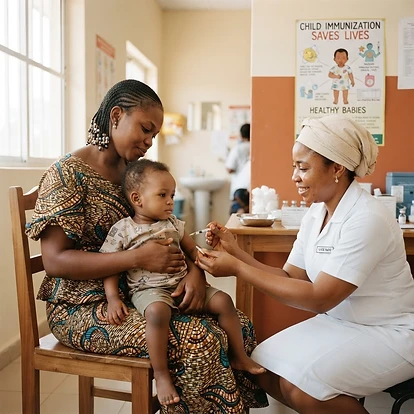
Nigeria's routine immunisation programme is free at government primary health centres, and it has protected millions of children from diseases that used to take them. Knowing what is coming — and when — removes a lot of the fear.
The schedule at a glance
Below is the shape of the national routine schedule. Local timing can vary slightly, and programmes are updated from time to time, so always confirm with your health centre and bring your child's card to every visit.
At birth: BCG (against tuberculosis), Hepatitis B birth dose, and oral polio vaccine (OPV0).
6 weeks: Penta 1 (diphtheria, tetanus, pertussis, hepatitis B and Hib in one shot), OPV 1, PCV 1 (pneumococcal), and rotavirus vaccine 1.
10 weeks: Penta 2, OPV 2, PCV 2, rotavirus 2.
14 weeks: Penta 3, OPV 3, PCV 3, and IPV (inactivated polio). Some centres also give a third rotavirus dose depending on the vaccine in use.
9 months: Measles 1, yellow fever, and meningitis A vaccine.
15 months: Measles 2 (often given as measles-rubella).
Later childhood brings boosters, and from around age 9 girls are offered the HPV vaccine. Pregnant women are routinely offered tetanus-diphtheria (Td) doses during antenatal care.
What happens at the visit
The nurse checks your child's card and weight, asks about any illness since the last visit, then gives the vaccine. BCG goes into the skin of the upper arm; most others go into the thigh or upper arm. The whole visit usually takes under half an hour if you arrive early.
Bring the card every time. If you have lost it, tell the health worker — they can help reconstruct the history rather than restarting everything.
Mild reactions are normal
- Tenderness, redness or a small swelling where the injection went in
- Mild fever in the first 24 to 48 hours
- Fussiness, sleepiness, or a slightly reduced appetite for a day
- A small blister then a scar at the BCG site — expected, and a sign it worked
Keep your baby comfortable, offer extra breastfeeds, and dress them lightly. Ask the nurse whether paracetamol is appropriate for your child's age and weight, and never exceed the dose they give you.
When to go back to the clinic
High fever that does not settle, a swelling that keeps growing and is hot, persistent crying for hours, difficulty breathing, a rash spreading over the body, limpness, or a seizure. These are uncommon, but treat them as urgent.
Common questions mothers ask
My baby has a cold — should I skip the visit? A mild cold is usually not a reason to delay. The nurse will decide; a high fever or serious illness may mean coming back in a few days.
Can I give the vaccine while breastfeeding? Yes. Breastfeeding is not a barrier, and feeding during or right after the injection comforts your baby.
Are the vaccines safe? Routine vaccines used in Nigeria go through national regulatory review and are monitored for side effects. The diseases they prevent — measles, pneumonia, diarrhoea from rotavirus, tetanus — remain far more dangerous than the vaccines.
We missed a date. Go as soon as you can. Children who fall behind do not have to start over; the health worker will work out what is next.
Before baby arrives
If you are still pregnant, ask your antenatal clinic which immunisation centre is closest to you, and note that the first visit is at birth — often before you leave the hospital or within the first days. Our guide for first-time mothers covers the rest of the newborn basics, and the Learning Hub has a newborn care course you can work through at your own pace.
This is general information, not medical advice, and Nigeria's schedule is periodically updated. Your primary health centre, midwife or paediatrician is the authority for your child's vaccinations.


