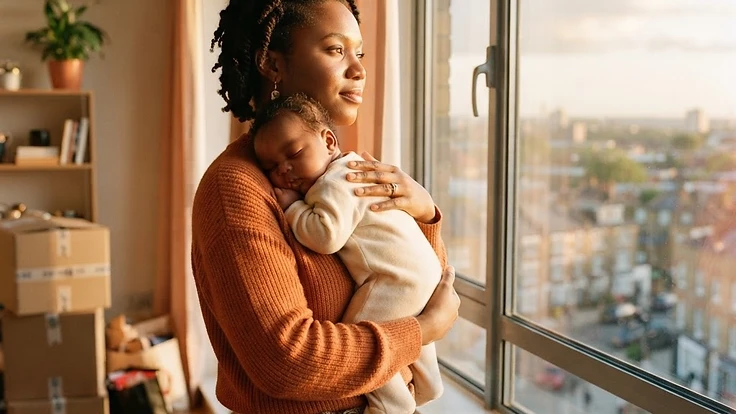
They tell you it takes a village. What they don't tell you is that the village doesn't come with you when you move.
Maybe you came to Lagos for work — one small box of dreams and a pregnancy test in your handbag. Maybe you married into a new state, and now you're learning that "we're family now" means you at a dining table with people whose language you're still catching, smiling at jokes you understand three seconds late. Maybe your husband's job moved everybody, and everybody means you, alone in a new house while he's at the office and the baby is on your chest, and your mother's voice on the phone says "pray about it" when what you need is somebody to just come and carry this child for one hour.
Here's what nobody names: you can love your new life and still grieve your old support. Both are true at the same time.
Back home, motherhood had infrastructure. Your mother appeared with pepper soup before you even asked, because she knew your face from birth and could read your tiredness through a phone call. Your aunties fought over who would watch the baby. Your sisters knew which market has the real tomatoes and which pharmacist won't cheat you. You never had to ask, because love back home didn't wait for permission — it just showed up, at the door, with soup.
And now? Now you have to build, from zero, what you were born into. In a city where the neighbour greets you but doesn't know you. Where the women at church are kind but already have their own circles, formed years before you arrived. Where asking for help feels like imposing, because you haven't yet earned the intimacy that back home was simply your birthright.
Some days the loneliness is louder than the baby's cries. Say it, because it's true and you're allowed: this is hard. This is harder than anyone warned you it would be.
But hear this: a village can be built. It just can't be imported.
The neighbour who greeted you twice — that's not nothing. That's a seed. Greet her three times, then four, then one day say, "I'm making soup, let me send you some" — because in Nigeria, food is how strangers begin. The mother you keep meeting at the clinic, the one whose baby is your baby's age — she is also new somewhere, or also lonely, or also waiting. The woman in your estate who hangs clothes in the morning when you hang clothes — start with the weather, end with phone numbers. None of these are small. Compounds were built from exactly these mornings.
And let yourself be helped. This is the hard one, especially for the strong ones. Receiving help is not begging; it's how a stranger becomes family. When the woman downstairs says "bring the baby, I'll watch her while you rest" — go. Don't polish your pride in front of your own rescue.
For the seasons you can't build yet
Newborn months. The year your husband travels. The depression nobody in your family believes in. Some seasons, you cannot dig a well — you just need water, today. For those seasons, MomCircleNG exists: connect with mothers in your new city by location and parenting stage — Lagos, Abuja, wherever "away" now is — talk daily in the WhatsApp community where somebody is always awake, because 2am loneliness doesn't check your time zone. The village your mother gave you can't transfer. But a village that chose you can be found.
Home was never just the place. Home is where your people are — and some of them haven't met you yet.
You were never meant to do this alone — and now, you don't have to be.
Community • Support • Growth


