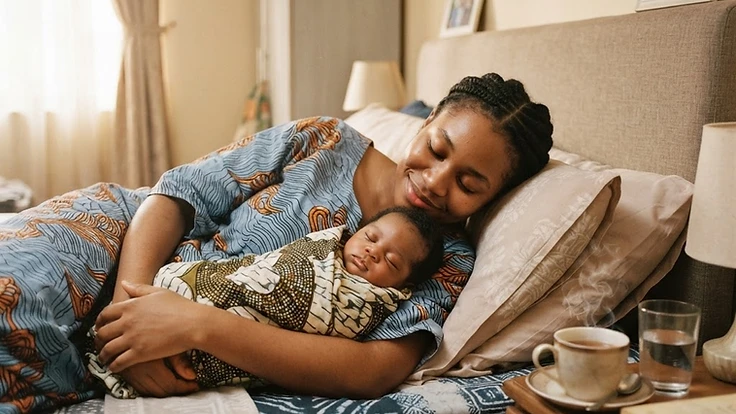
Let me tell you something nobody says out loud: the whole world prepares you for the birth, and almost nobody prepares you for the weeks after it.
Everyone asks about the baby. How is the baby? What did you deliver? Boy or girl? And you, mama — the one who did the delivering — you are sitting there leaking, sore, exhausted, stitched or cut, running on two hours of sleep, smiling and saying "we thank God."
This article is for you. Not the baby. You.
I'm not a doctor, and this is not medical advice — your own body and your own doctor come first. But here is the honest map of what recovery usually looks like, week by week, for both normal delivery and C-section — so you know what is normal, and what is not.
Week 1: the deep, tender beginning
Whether your baby came into this world the vaginal way or through a C-section, this first week is tender for every mother — just in different places.
If you had a normal delivery: you will bleed. This bleeding (doctors call it lochia) is the body cleaning out what it no longer needs. It starts heavy, brighter red, then slowly reduces over the weeks. You may be sore where you delivered, and if you had stitches, sitting down becomes an art form — a cushion or a warm-ish bath helps. Rest. Rest. Rest.
If you had a C-section: hear me clearly — you did not "take the easy way." You had major abdominal surgery and delivered a baby in the same day. That is a double crown. Your incision will be tender; keep the area clean and dry as your doctor showed you, and let nobody make you lift heavy things — including, as much as possible, anything heavier than your baby.
Both paths: your tummy will still be rounded. Your body has not read your timeline. It carried a human — give it the same patience you would give your best friend.
Go back to the hospital straight away if: the bleeding soaks a pad very fast, you have a fever, the bleeding smells foul, you have severe pain that keeps getting worse, or your C-section incision becomes red, hot, or leaks. These are not "manage at home" signs. Ever.
Weeks 2–3: slow, not straight
Somewhere in this stretch, the visitors thin out, your partner returns to work, and people start expecting you to be "back." You are not back. You are healing.
This is when the tears can come easily — the baby blues visit most mothers in these weeks, and they are real and they pass. Sleep when the baby sleeps. I know you have heard it a hundred times, because it is true a hundred times.
Your bleeding should be much lighter now — more like the end of a period, then brownish, then stopping. If it suddenly becomes bright and heavy again, that is your body telling you that you are doing too much — lie down. And if it never lightened at all, that is a hospital visit, not a wait-and-see.
Your body is not weak. It is recovering at the only speed recovery knows — slow.
Weeks 4–6: the quiet comeback
This is when most mothers start feeling like a person again — a tired person, but a person. The bleeding has usually stopped. The C-section incision is healing into a scar you will learn to call your badge. Energy returns in small sputters, like NEPA light after the hold-up — a little today, more next week.
Somewhere around the six-week mark is your postnatal check-up. Please keep it, even if you feel fine — it is where the doctors confirm the inside is healing as beautifully as the outside, and it is your safe space to ask everything you have been whispering to Google.
And gently, mama: six weeks "cleared" does not mean six weeks "back to before." Some mothers need three months. Some need a year. Your timeline belongs to you and your doctor — not to your cousin's opinion, and not to social media.
The part they don't put in any guide
Recovery is not only physical. You may look in the mirror and not recognise the woman looking back. You may love your baby fiercely and still grieve your old life quietly, and both of those can be true at once. That is not ingratitude. That is being human.
If the sadness stays and deepens — if you cannot sleep even when the baby sleeps, if everything feels grey, if frightening thoughts come — that is beyond baby blues, and it deserves real help, the same way a fever deserves a hospital. Speak to your doctor. Speak to us. There is no shame anywhere in this circle.
You spent nine months growing a life. Give your body and your heart the grace to heal at their own pace — and never, ever alone.
Find your postpartum support 🤎
Recovery is not a solo assignment. Find trusted postpartum consultants, doulas and service providers in the MomCircleNG marketplace — women who can walk the weeks after birth with you.
Find postpartum support →What are you carrying right now? 🤎
The weeks after birth carry joy, fear and a hundred quiet questions. Take two minutes for you — the Mum Check-In is a gentle, honest space to ask yourself how you're really doing.
Take the Mum Check-In →Community • Support • Growth


