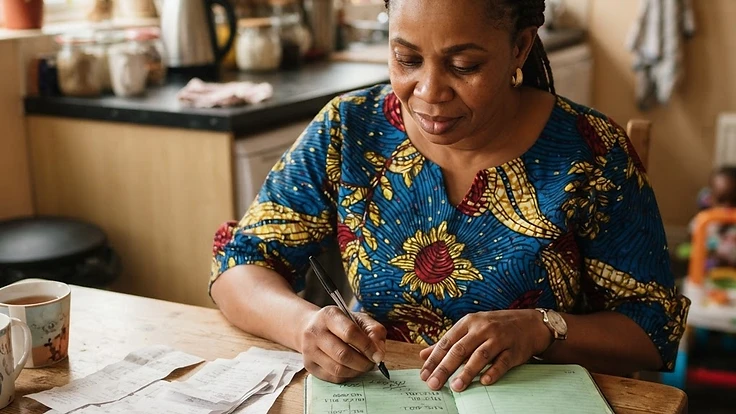
Money worries have a way of making a mother feel she is failing in silence — at the market, at the school gate, when fees are due. But a budget is not a cage; it is a kind of clarity. It tells the truth about what you have, so you can stop carrying a worry that has no shape.
Start small. Write down what comes in and what must go out each month — the fixed things first (feeding, light, transport, fees). Then mark one small line for yourself, however tiny. A budget that has no room for the mother is a budget that burns her out. Even a thousand naira a week for yourself is a statement: that you also live in this home.
Money clarity, not money fear
A budget is not a punishment — it is a map of your reality. Fear of money grows in the dark; writing it down shines a light. Once you can see what you have and what you owe, the worry loosens its grip, even if the numbers are hard. Try a simple monthly sheet:
- Fixed must-haves: feeding, light, data, transport, school fees, rent, medical, household items.
- Obligations: family contributions, debts, tithe or charity.
- A small line for yourself — even ₦1,000–₦3,000 a week. This is the line that keeps you in the budget, not only serving it.
- A buffer: whatever tiny amount you can. ₦2,000 saved monthly is still savings.
Practical ways money goes further in a Nigerian home
- Buy staples in bulk during month-end market runs — rice, beans, garri, oil, tomatoes for paste. Prices climb toward mid-month.
- Cook in batches and freeze. One big pot of stew stretched across the week saves both money and 6pm panic.
- Track the small leaks — daily "soft" spending on snacks, airtime top-ups, rides. They rarely feel like money until you add them up.
- Revisit subscriptions and data. Downgrade what you don't use before cutting the things that refill you.
- Move savings out the moment income lands, not "whatever is left." There is rarely anything left.
Talking about money with your partner
Take the money conversation out of the kitchen and into the open. Sit once a month — even for ten minutes — and name the real numbers: what came in, what must go out, what you owe, what you're saving for. Fees, savings, debts, dreams — name them before they become emergencies. If money talk keeps turning into money fights, agree on a calm script beforehand: "This isn't blame. This is planning."
When there is genuinely not enough
If the numbers will not stretch — fees are due, debt is rising, food is tight — that is not a personal failure; it is a math problem to solve with help. Speak to a trusted person, a faith community, a cooperative, or a financial adviser. Carrying money fear alone is what breaks a mother, not the number itself.
Where you can, take the money conversation out of the kitchen and into the open with your partner. Fees, savings, debts, dreams — name them before they become emergencies. The goal is not a spreadsheet you fear. The goal is a home where money is a tool, not a daily panic. You are allowed to plan for your children and for yourself at the same time.


