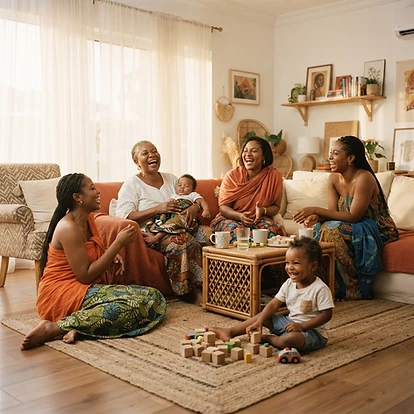
There is a particular kind of tiredness that has nothing to do with sleep. It is the tiredness of a mother who is doing all of it, mostly alone, and who has quietly stopped expecting anyone to notice.
We call it loneliness when we are being honest, and something else when we are not. In Nigeria we are rarely alone. There are relatives in the compound, a church or mosque family, neighbours who greet you, a WhatsApp group that never sleeps. So how can a woman surrounded by people be lonely? Easily. Being surrounded is not the same as being held.
This guide is about the difference between the two, and how to move from one to the other.
What a village actually is
A village is not a crowd, and it is not a mood. It is a small number of people who can reliably do specific things for you, and to whom you can reliably do the same. That is it. If a relationship cannot be relied on for anything in particular, it is pleasant company, and pleasant company is good, but it will not carry you through a hard week.
What makes support real is not affection, it is predictability. The friend who says “let me know if you need anything” is different from the one who turns up on Thursday because Thursday is when you have the antenatal appointment and somebody has to hold the baby.
The three kinds of support every mother needs
Researchers who study social support generally split it into three kinds, and the split is useful because most of us are strong in one and starved in another.
Practical support
Hands. Someone who takes the children for two hours, drops food at the door, sits with your mother in hospital, or picks up your daughter from school when traffic swallows the afternoon. This is the support that Nigerian mothers most often ask for and least often receive in a form they did not have to fight for.
Emotional support
A person you can tell the truth to without managing her reaction. Not advice, not a Bible verse before you have finished the sentence, not “at least you have a child.” Just a human being who can hear “I am not coping today” and stay in the room.
Informational support
Somebody who has been where you are and can tell you which hospital actually answers the phone at night, which school is not worth the fees, which paediatrician listens, which market seller will not cheat you. In Nigeria this kind of knowledge is worth more than money, and it is passed almost entirely by word of mouth between women.
Most mothers are drowning in one of these three and quietly starving in another. Naming which one is missing turns a vague feeling of “nobody is there for me” into something you can actually go and find.
What the evidence says about isolation
This is not only a feeling to be managed. Social connection is a health issue.
The stress-buffering model, set out by Sheldon Cohen and Thomas Wills in Psychological Bulletin in 1985, describes how supportive relationships change the way the body responds to stress: the same pressure lands differently when a person is not carrying it alone. Later work by Julianne Holt-Lunstad and colleagues, published in PLOS Medicine in 2010, reviewed a large body of studies and found that people with stronger social relationships had better survival outcomes across the follow-up periods studied. The World Health Organization now treats social isolation and loneliness as a public health concern in its own right.
For mothers specifically, the picture that emerges from perinatal mental health research is consistent: poor support is one of the strongest correlates of postpartum depression and anxiety, and practical help in the early months is protective. You do not need to be in crisis for this to matter. Support is not an intervention you reach for when things fall apart. It is the thing that keeps them from falling apart.
Which is why it is worth being blunt: a mother with no reliable support is not simply having a hard time. She is carrying a known risk, and she should not be expected to manage it with positive thinking.
The Nigerian version, honestly
We are often told that our culture already solved this. Extended family, communal child-rearing, the church, the mosque, the age-grade, the estate association. There is truth in it, and there is also something we rarely say out loud.
What still works
Where family is close and willing, it remains the strongest support system available to a Nigerian mother, and nothing online replaces a grandmother who can actually take the baby. Faith communities still produce real, practical help: the women's fellowship that cooks when there is a birth, the group that shows up for a funeral. Estate and compound networks do the small daily things that no app can.
What does not
Support that comes with a price is not support. It is a debt. Many mothers have a village that is technically present and practically unavailable: relatives who will take the child but remind you of it for two years, help that arrives with commentary on your marriage, an in-law whose assistance is really supervision. Others have the opposite problem. They moved for work, or for marriage, or for safety, and the village stayed behind in another state.
And some villages are not safe. If the people around you are the ones hurting you, more contact is not the answer. Distance is. This guide assumes a mother who needs support, not a mother who needs protection. If you are being harmed, please treat that as the priority, and speak to someone qualified to help you.
Why the village feels harder than it used to
Three things have changed, and none of them are your fault.
The first is that we move. A mother raised in one town, married into another, working in a third, has no automatic network where she lives.
The second is that women now carry both roles. The woman who would have been home at 3pm, available for the school run and the afternoon visit, is at work. Her own support is outsourced or absent, and she has less margin to give.
The third is that we replaced the compound with the phone. WhatsApp groups are not nothing. They kept many of us sane through lockdown and they are where real help gets organised. But a group chat cannot hold your baby. Online connection is a bridge. It is not a village, and treating it as one leaves a gap you cannot name.
Building one deliberately, in ninety days
You cannot manufacture a village on demand. You can, however, do a small number of things on purpose, and most mothers never do them because nobody ever framed friendship and support as something you work at.
Week 1: Map what you already have
Write down every person within reach, even loosely: family, neighbours, school parents, colleagues, church members, old friends, the woman from antenatal whose number you saved. Beside each name, note which of the three supports she could plausibly give. You will usually find that you have more informational contacts than practical ones, and almost no one in the emotional column. That is the gap to fill.
Weeks 2 to 4: Make one ask
Not a general plea. One person, one specific thing, one day. “Can you take Amara on Saturday morning for two hours?” is a request a person can actually answer. “I need help” is not. Expect some no's. A no is information about that person's week, not a verdict on your worth.
Weeks 3 to 8: Join something with repetition in it
Friendship needs proximity, repetition and a little vulnerability, in that order. Repetition is the one people skip. A single event produces a pleasant afternoon and no relationship. The same group, on the same day, every week, produces friends. A church unit, a school committee, a fitness class, an antenatal refresher, a book club, or a MomCircleNG circle all work for the same reason: they put you in front of the same women often enough that something can grow.
Weeks 4 to 12: Give first
The fastest route into a village is to become one. Offer the lift, send the food, remember the appointment. This is not manipulation, it is how reciprocity starts. But keep an eye on the direction of traffic. If you are always the one giving, you have found someone who needs a village, not someone who can be yours.
How MomCircleNG fits
We are honest about this: an app is a supplement, never a replacement. If you have family who can genuinely help, go to them first. If you have a faith community, lean on it.
What MomCircleNG adds is the piece most mothers cannot find locally: a vetted group of women in your stage of motherhood, in your city, who meet on a rhythm rather than at random. Our circles are small on purpose, because a circle of forty is a crowd and a circle of eight is a village. The Wednesday voice chats exist because hearing a woman's actual voice is different from reading her message. The meetups exist because the bridge between online and real life has to be walked at some point.
If you want a first step that costs nothing, come and see: browse the community, read what other mothers are saying, or take the two-minute check-in and find out where you actually are before you decide what you need.
The thing worth saying plainly
Needing other women is not weakness, and it is not un-Nigerian, and it is not something you grow out of. Every mother who looks like she is managing alone is either unusually supported, unusually resourced, or quietly falling apart where you cannot see.
You were never meant to do this by yourself. Build the village. It will take longer than you want and it will be worth it.
Where to go next
- If you have no village at all: read When You Have No Village.
- If you are newly postpartum: read How to Build a Support System as a New Mother in Nigeria.
- If you want the practical friendship skills: read Making Friends as a Mum.
- If you want to be in the room: become a member and join a circle, or come to an open meetup first.


