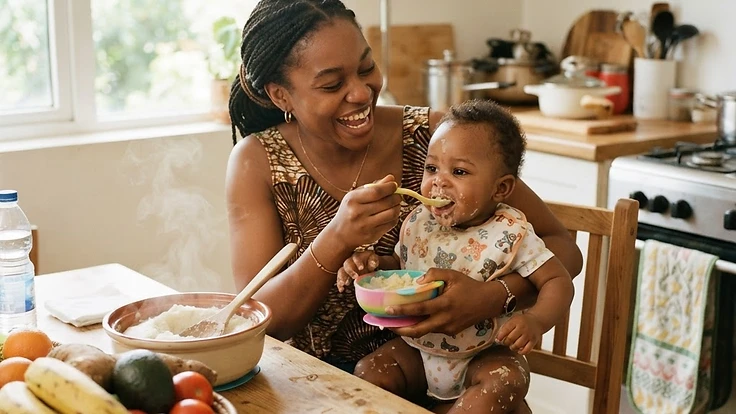
Six months. Half a year old. And now, everybody — from the market woman to your aunties on WhatsApp — has an opinion about what your baby should be eating.
Some will tell you to start food at three months (please don't — experts say milk only until around six months). Some will tell you pap alone is enough for the next year (it isn't). Somewhere in the middle of all that noise, you just want somebody to tell you, plainly, what to put in your baby's mouth this week.
That's what this timetable is. Real Nigerian food, week by week, no pressure, no buying expensive imported baby cereal when your kitchen already holds everything you need.
One honest note before we start: every baby is different, and before you begin weaning, run it past your pediatrician — especially if your baby was born early or has any health condition. This timetable is a loving guide, not a prescription.
Week 1: one food, one spoon, one mission
The first week is not about nutrition yet — milk (breast milk or formula) is still doing almost all the feeding. The first week is about learning: this is what a spoon is. This is what food feels like.
- Start with plain, smooth, thin pap/ogi made from millet, guinea corn or maize — you can mix it with expressed breast milk or formula instead of just water for extra goodness. Cool it properly. It should drip, not plop.
- One meal a day, after a milk feed (a hungry baby has no patience for lessons). A few spoons is a full success.
- Do not add sugar, honey or "taste it sweet for her." Baby does not need sweetness to accept food — she needs you to be relaxed.
Week 2–3: thickening up, adding variety
Once the spoon is accepted, start thickening the pap slowly — a thicker pap stays on the spoon and gives more substance. Now you can begin introducing one new food at a time, a few days apart, so you can watch how your baby responds:
- Mashed sweet potato (soft, smooth, mixed with a little breast milk or formula)
- Mashed yam or Irish potato with a tiny bit of oil or breast milk to soften
- Puréed pumpkin (ugu) or carrots, cooked soft and blended
- Rice porridge (congee-style) — well-cooked rice boiled soft and mashed smooth
Move to two meals a day. Let baby touch the food, smear the food, and yes, wear the food. Mess is part of the lesson, mama — a bib and a damp cloth nearby save your sanity.
Week 4–6: texture, protein, family food begins
This is where Nigerian food truly shines. Around weeks 4–6 you can start:
- Moin moin (soft, not spicy, sieved smooth if needed) — an excellent protein source
- Well-mashed beans (ewa) with palm oil, sieved or mashed very smooth
- Soft mashed fish — properly de-boned, fresh, not dried-fish-with-bones-and-pepper
- Mashed plantain (ripe) — soft and naturally sweet
- Pap + a spoon of well-mashed moin moin or beans — the classic Nigerian combo that fed generations
Move toward three small meals a day, with milk feeds before or between. From this stage, your baby can start joining soft, unseasoned versions of the family food — which is the beautiful end goal: one pot, one family.
A sample day at 6 months (from week 4)
- Morning: milk feed, then pap/ogi
- Midday: mashed sweet potato or yam + a little oil
- Afternoon: milk feed
- Evening: pap, or rice porridge, or mashed plantain
- Night: milk feed (milk is still the main food until 12 months — food comes to assist, not replace)
What NOT to give before 12 months — read this twice
- Honey — never before 12 months (it can make babies seriously ill)
- Cow's milk as a drink (small amounts in pap are fine; as the main drink, no)
- Salt, seasoning cubes, pepper — baby's kidneys and tongue don't need them
- Sugary drinks, soft drinks, "just a taste" — no
- Whole nuts, groundnuts, hard chunks — choking risks. If you give nut anything, it must be in smooth paste form
- Anything sized or shaped to choke on — food should be soft enough to mash between your fingers
The part nobody tells you
Some days your baby will eat like a champion. Some days she will clamp her mouth, turn her face, and make you feel like the world's worst cook. Neither day means anything about your mothering. In the first year, milk remains the main act and food is the apprentice — some days the apprentice shows up, some days he doesn't. Keep showing up gently, and she will get there.
You are not behind, and your baby is not spoiled, and your food is not inferior. Nigerian kitchens have been weaning healthy, chunky, glowing babies for generations. Trust your food, trust your pediatrician, and let your baby set her own pace — with you beside her, every spoon of the way.
You were never meant to figure this out alone.
Community • Support • Growth


