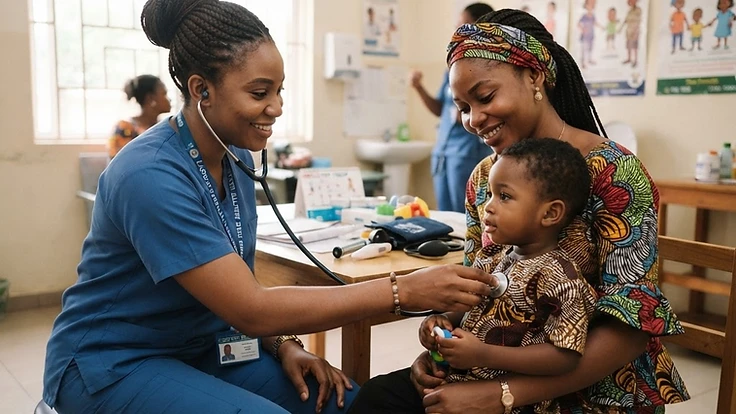
Children get sick. It is part of growing up, and most common illnesses are mild and pass at home. But as a mum, knowing what to watch and when a symptom crosses the line from “manageable” to “needs a doctor now” is one of the most important skills you can build. This guide covers common childhood illnesses in Nigeria and the red flags to act on.
This article is for education and is not a substitute for medical care. It does not diagnose any child. When in doubt, always contact your healthcare provider.
Fever
A fever is a body temperature above about 38°C. Infections are the most common cause. What you can monitor at home: keep your child comfortable, give plenty of fluids, dress lightly (do not over-bundle), and use paracetamol at the correct age/weight dose if advised by your doctor. Seek help urgently for: a fever in a baby under 3 months; a very high or persistent fever; a child who is drowsy, floppy, not feeding, has a stiff neck, a non-blanching rash, difficulty breathing, or repeated vomiting.
Cough and cold
Most coughs and colds are viral and improve in a week or so. Comfort measures include fluids, rest, and keeping the nose clear with saline drops. Seek help if breathing is fast, laboured, or noisy even when calm; if the chest draws in between the ribs; if there is a persistent high fever, bluish lips, refusal to feed, or the cough lasts beyond 2–3 weeks. Cough medicines are generally not recommended for young children.
Diarrhoea and vomiting
These are common and the main danger is dehydration. Give oral rehydration solution (ORS) frequently in small sips, continue breastfeeding/feeding if possible, and watch for dehydration. Red flags: sunken eyes, dry mouth, no tears when crying, very little or no urine, lethargy, blood in the stool, persistent vomiting, or a baby under 6 months with diarrhoea/vomiting.
Rashes
Many rashes are mild (heat rash, mild eczema, mild reactions). Seek help urgently for: a rash that does not fade when you press a clear glass against it (non-blanching), a spreading rash with fever, blistering, or swelling around the eyes/lips.
Sore throat and ear pain
Often viral. Comfort with fluids and paracetamol if advised. Seek help for severe pain, high fever, difficulty swallowing, drooling, a child unable to drink, or ear pain with discharge — these may need antibiotics.
Conjunctivitis
Red, sticky eyes are common. Clean gently with cooled boiled water and a clean cotton pad, one eye per pad, from the inner to outer corner. Seek help if there is swelling, a lot of thick discharge, sensitivity to light, or it does not improve in a few days.
Malaria concerns
In Nigeria, malaria is common and can be serious, especially in young children. Symptoms include fever, chills, headache, weakness, vomiting and sometimes diarrhoea. Any unexplained fever in a child in a malaria area should be treated as possible malaria until tested — see a healthcare provider for a test and proper treatment. Do not self-treat blindly. Prevention matters: use treated mosquito nets, window screens, and repellents where appropriate.
Dehydration
Dehydration can follow diarrhoea, vomiting, fever, or poor feeding in hot weather. Signs: dry mouth, sunken eyes/fontanelle (in babies), few or no wet nappies, lethargy. Give ORS and fluids. Seek help urgently if your child cannot keep fluids down, has no urine for several hours, or is drowsy.
Respiratory symptoms — when to worry
Fast breathing, chest indrawing, grunting, flaring nostrils, or a child too breathless to feed or speak are emergency signs — seek care immediately. Pneumonia can develop quickly in young children.
When to seek help — general red flags
Act immediately if your child shows any of these:
- Difficulty breathing or fast/laboured breathing.
- Drowsiness, unresponsiveness, or a seizure/convulsion.
- Dehydration (no urine, sunken eyes, dry mouth, lethargy).
- A non-blanching rash with fever.
- Severe or persistent pain.
- Fever in a baby under 3 months.
- Any condition you feel is “not right” and getting worse.
Frequently asked questions
Should I give antibiotics for every fever?
No. Most fevers in children are viral and antibiotics do not help viral infections. Only a healthcare provider should decide if antibiotics are needed after examination and tests.
When can I manage at home?
When your child is alert, drinking, feeding reasonably, breathing comfortably, and improving — with close watching. If anything worries you or fits a red flag above, seek care.
For community support and to connect with other mums, visit the MomCircleNG Community. For non-emergency guidance, try Mama AI in the Assistant. In an emergency, go to the nearest hospital.


