Somewhere in Nigeria right now, an aunty is asking a mother: "Ah, he's still wearing diapers at this age?" — and that mother is smiling politely while quietly panicking inside.
If that aunty has visited your house too, mama, take a breath. Potty training is not a competition, and your child is not falling behind. It is a skill — like walking and talking — that every child masters at their own pace. Some are ready at 18 months. Many are not ready until three. Both are normal.
Here is a warm, honest guide to doing this well — without pressure, without shame, and without turning your bathroom into a battleground.
First: is your child actually ready?
Readiness matters far more than age. Watch for these signs — when you see several together, it's time:
- Dry stretches: their diaper stays dry for two hours or more (their body is learning to hold it)
- They notice: they tell you they've peed or pooped, hide behind the curtain to go, or look uncomfortable in a soiled diaper
- They're curious: they follow you to the bathroom, want to flush, or imitate wiping
- They follow simple instructions: "come", "sit down", "bring your shoes"
- Predictable poops: you can roughly guess when they usually go
If you're only seeing ONE of these, give it a few more weeks. A child who isn't ready cannot be forced into being ready — you'll only both end up crying (and only one of you in the bathroom).
Choose your moment wisely
Even a ready child struggles during big changes. DON'T start (or pause if you've started) when:
- A new baby has just arrived
- You've just moved house or the family routine has been turned upside down
- They've just started a new school or creche
- They're sick or teething badly
And a note on our culture: don't start because of pressure from relatives. Aunties will always have opinions — even after your child is fully trained, they'll have opinions about something else. Your job is your child's confidence, not their commentary.
Getting ready (the Nigerian mom's shopping list)
- A potty: a small floor potty is best for beginners — the big toilet hole is scary for many toddlers. Available at any baby shop or online store; let your child pick the color if you can — ownership builds excitement.
- Easy clothes: elastic-waist trousers they can pull down themselves. During training season, avoid dungarees, tight leggings and anything with ten buttons. Dress them for speed, not fashion.
- Underwear they'll love: fun pants with their favorite thing — animals, cars, princesses. Many toddlers protect pants they love more than diapers.
- A step stool (for later, when they graduate to the big toilet)
- Patience. (Not for sale in the market, but you'll need plenty.)
The method that works (gently)
1. Introduce the potty casually. Put it where they can see it. Let them sit on it fully clothed. Read a book about going potty — familiarity before function.
2. Build a routine. Sit them on the potty at natural "go" moments: after waking up, after meals, before bath. Even if nothing happens — the routine is the lesson. Keep it light: 3-5 minutes, no longer, no forcing. Never hold them down.
3. Narrate everything simply. Use the words your family will use — "pee-pee", "wee-wee", whatever is natural in your home — and use them consistently so grandparents and nannies say the same thing.
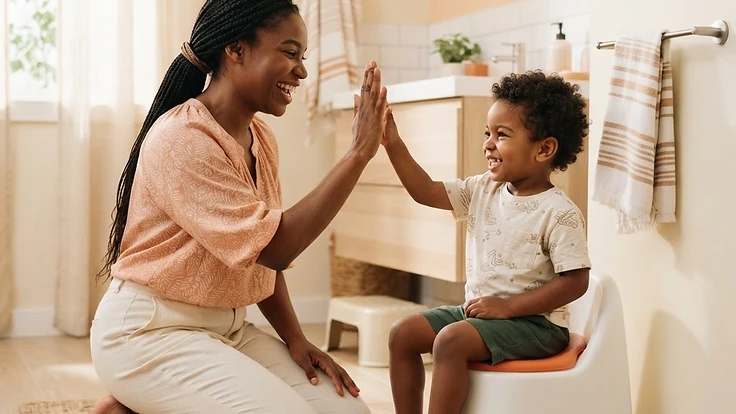
4. Celebrate every success like they won a medal. Clap, dance, high-five, call Daddy to announce the good news. Toddlers repeat what gets applause.
5. When accidents happen (they WILL happen): calm voice, zero drama. "It's okay, pee-pee goes in the potty. Let's clean up together." Change them and move on. Your calm face teaches them: this is safe, mistakes are fine, I'm learning.
NEVER punish, shame, or compare. No "see your cousin, she's a big girl." No forcing them to sit in wetness to "teach them a lesson." Shame doesn't speed up training — it slows it down, and it can teach your child to hide accidents (which creates bigger problems like holding poop).
6. Keep caregivers consistent. Grandma, nanny, Aunty at the creche — everyone should follow the same routine, the same words, the same no-shame approach. Consistency across caregivers is one of the biggest success factors.
Troubleshooting (the honest parts nobody warns you about)
"He refuses to sit on it at all." Pause for 2-3 weeks. Forcing creates a battle you cannot win — a toddler's will is stronger than yours, and that's actually a good sign for their future.
"She pees in the potty but hides to poop." Very common. Pooping takes more control and focus. Keep encouraging, keep it pressure-free, and watch for the hiding pattern — invite them to the potty at that hiding time.
"He was doing well and suddenly regressed." Regression usually means something: a new sibling, starting school, illness, or stress. Find the cause, comfort the child, restart gently. Regression is a pause, not a failure.
"She's terrified of the toilet." Fair — the hole is genuinely scary to a small person. Stay on the floor potty longer. You can flush together AFTER they've left the bathroom, so the loud sound isn't associated with fear.
Nighttime is a separate skill. Daytime dryness usually comes first; night dryness can take months or even years longer and often just needs the body's own development. Diapers at night for as long as needed — that's normal, not failure.
When to check with your doctor
Please see your paediatrician if you notice:
- Pain or crying when peeing or pooping
- Blood in urine or stool
- A child past 4 with no readiness signs at all
- Hard, painful stools or full toilet avoidance for days
- Regression after months of full dryness (can sometimes follow an infection)
This article is education from one mama to another — for anything that worries you, your doctor is the right first call.
Ask the mamas who've done it
Every mother in your family line has potty-trained somebody. But the mothers walking YOUR exact season — with YOUR culture, YOUR creche, YOUR kind of toddler — are in MomCircleNG.
Ask them: what worked? What almost broke them? Which potty is actually easy to clean? Mamas in our community share real experiences daily, from first-day victories to month-three regressions, and every child in between.
You don't have to do motherhood alone. And you definitely don't have to potty-train alone.
Frequently asked questions
What's the right age to start potty training? Anywhere between 18 months and 3 years is normal. Readiness signs matter far more than the birthday — a ready 2-year-old trains faster than a pressured 2-year-old.
Can I potty train in 3 days? Some toddlers with strong readiness signs do respond well to intensive long-weekend methods. Most Nigerian families find steady, low-pressure routine training kinder and more durable — especially with school, nannies and grandparents in the mix.
What about when we're traveling or at the market? Pack a portable potty or use disposable training pants for outings only — don't let logistics stress the child. Home mastery first, public confidence after.
My mother-in-law says I'm wasting time being gentle. What do I do? Share this: research and generations of experience agree that shame and pressure slow training and can cause withholding and hiding. Gentle isn't lazy — gentle is effective.
Your child WILL get there
One day soon — sooner than the tired season allows you to believe — your child will walk to that potty by themselves, and you'll feel a proudness that surprises you. All the laundry, all the patience, all the calm-voiced cleanups will have built something: not just a trained child, but a child who knows mistakes are safe and learning is joyful.
Until then, breathe. Celebrate small wins. And let your circle carry you.
Community • Support • Growth
Join the Circle
The mamas who've potty-trained through your exact season are already here. Ask them anything.
Become a Member


