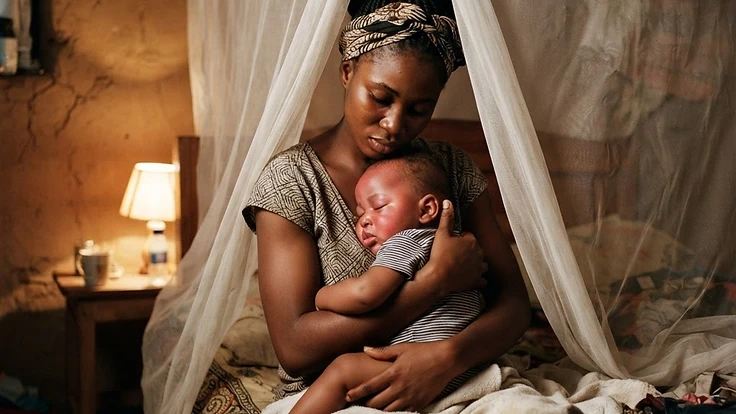
In Nigeria, malaria is not a distant textbook disease. It is in our compound, our clinic queue, our own childhood memories. And it carries a whisper of fear that every Nigerian mother knows — because we have all heard a story that ended badly, usually one that started with "they said it's just fever."
So let's talk about this honestly and calmly. Because malaria, caught early and handled by professionals, is one of the most treatable sicknesses we know. The danger has never been malaria itself — the danger is delay.
First: the only way to truly "know"
Here is the truth that separates fear from safety: you cannot confirm malaria by looking. Fever, hot body, poor feeding, vomiting — all of these can be malaria, and all of these can be something else entirely. Even we doctors' mothers cannot tell by touching the forehead — and neither can the pharmacist down the road.
The only way to know is a test — a simple rapid test or blood test done at a proper hospital or clinic. It takes minutes, and it is the difference between treating the right thing and mistreating everything.
This is why the worst advice in Nigeria is not even "don't go" — it is "just start malaria medicine, it's probably malaria." Medicines for malaria without a test means: maybe treating what isn't there, missing what is, and teaching your child's body the wrong lessons. Please — this article won't tell you what to give, and neither should your neighbor. Test first. Always test first.
The signs that say "go and test today"
Take your child to be tested — today, not "when it gets worse" — if you notice:
- Fever, or a hot body (yes, even at night, even "small small")
- Your baby is refusing feeds or eating poorly
- Vomiting, or loose stools alongside fever
- Unusual sleepiness, weakness, or "the body is just not there"
- Complaints of headache or body pains (older children)
- Pale palms, pale inside of eyelids, or pale nails
And because malaria and mosquitoes write their story mostly at night, prevention is a mother's first job: sleep under a treated mosquito net — every night, every person, no exceptions. Net your windows where you can, clear standing water around the compound, and use whatever safe repellent your pharmacist or doctor recommends for your child's age.
The danger signs that mean: hospital, NOW
These signs say malaria (or something serious) has moved beyond "go and test today" into "go to the hospital this minute." Do not eat, do not sleep on it, do not wait for morning:
- Convulsions or seizures (any age)
- Your child is drowsy to the point of being hard to wake, or confused
- Refusing to drink anything, or unable to keep anything down
- High fever that will not come down
- Deep fast breathing, or difficulty breathing
- Dark or cola-colored urine
- Yellowing eyes
- A child who was walking and talking yesterday and today cannot stand or sit up
With these signs, you do not "wait to see." You go. Night bus, okada, neighbor's car — whatever moves, moves.
The part fear does not let us say
Mothers ask me quietly: "What if I rush to the hospital and it turns out to be nothing?" Mama. It has never once, in the history of medicine, been a waste for a mother to bring her child in time. The doctors will not laugh at you. The nurses will not roll their eyes. They will check your child, and you will either get treatment early — when it is easiest and cheapest and safest — or you will leave with peace. Peace is also a gift you buy for your child.
And if the test says malaria — do not faint and do not blame yourself. In our country, even the most careful mother can meet a stubborn mosquito. Malaria caught early is treated quickly, and children bounce back in a way that will amaze you. Follow the doctor's plan to the end — every tablet, every day, even when the child "has already improved," because stopping halfway is how malaria learns to fight harder next time.
Fear is allowed to come to the hospital with you. It is just not allowed to decide to stay home.
You were never meant to face it alone — and in this circle, you never have to.
Community • Support • Growth


