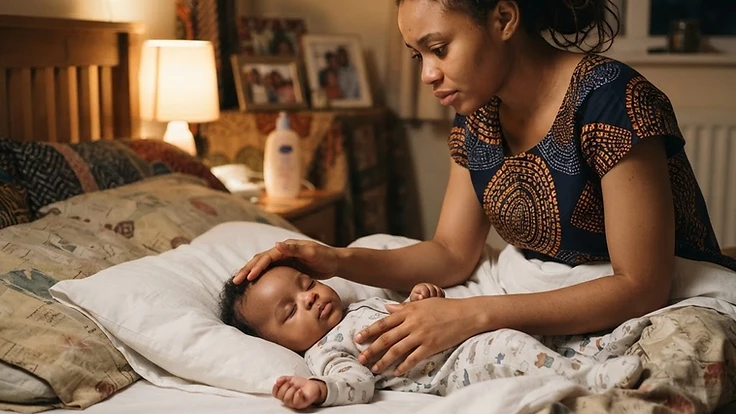
My daughter had fever for days.
Days. Not one hot forehead in the evening. Not one night of tossing and turning. Days of it — me checking her temperature what felt like every hour, her little body warm when I carried her, my heart doing that thing mothers' hearts do when something is wrong and you can't name it.
If you've been there — sitting by your baby at 2am, hand on their chest, counting their breathing — you know. Sometimes these kids will make you scared. Truly scared.
At first, I even thought it was teething. I told myself, she's probably just teething, this will pass. But somewhere deep down I knew — teething doesn't do this. Teething doesn't raise a temperature this high. That's something I want every mama to hear clearly: teething is the explanation we reach for, but it does not cause high fever. If your baby is burning up, teething is not the reason — don't let it delay you.
That night, when the fever climbed and climbed and nothing we did was bringing it down, the fear settled it for us. We packed a bag and left for the hospital at 4am. Four in the morning — me holding her, my heart pounding, praying the whole way there. And I would do it again at 4am tomorrow if I had to. Because that's what we do.
The tests said nothing — and that was the scariest part
The hospital did what hospitals do. They ran tests. And the tests came back clear. No bacteria. Nothing.
I remember standing there thinking, clear? What do you mean clear? My child is burning up and you're telling me nothing is wrong?
But the doctor explained something I've never forgotten: some fevers in children are viral, not bacterial. The fever is real — but there's no infection hiding anywhere that tests can find. It's the body doing its work. And viral fevers, he said, don't answer to antibiotics or panic. They simply take their time and pass.
Then he told me the part I didn't expect: when the fever finally breaks, a rash may follow.
A rash? After all that? I thought a rash meant things were getting worse. He smiled — the way doctors do when they're about to tell you something that will save you a night of fear — and said no. When fever comes first and the rash comes after, the rash is not the sickness returning. The rash is the end of the story. The body's closing chapter.
And that is exactly what happened. The fever passed. The rash came, lightly, just as he said it would. And then it was over — and my daughter was herself again.
(If you're curious, doctors have a name for this common pattern of fever-then-rash in little ones — some call it roseola, or "sixth disease." But that day, I only needed to know one thing: she would be okay.)
What I want every mama reading this to know
First: the clear tests were good news, not bad news. I had it backwards. A test coming back "clear" isn't the hospital failing to find the problem — sometimes it's the body telling you it's fighting something it can handle, and it just needs time and watching.
Second: fever is not something to manage by yourself at home with guesswork. Not even when a voice in your head whispers "it's probably just teething." This is not the place for "maybe it will pass by morning." Fever in a baby is for professionals. That is not me being dramatic — that is me, a mother who left her house at 4am, telling you plainly: you will never regret taking your child to be seen. The regret lives on the other side of that decision.
And third — the lesson that took me longest to learn: don't panic. I know how impossible that sounds at 2am with a hot baby on your chest. But panic doesn't cool a fever. Taking a breath, packing a bag, and going to see the pediatrician — that's what helps your child. Panic is what the fever does to us. The hospital is what we do about the fever.
When you should go to the hospital, straight away
I'm not a doctor, and this article won't tell you what to give or how to treat — that is your pediatrician's job, and every child is different. What I can share — as one mother to another — are the moments when you should not wait and watch at home:
- Your baby is under three months old with any fever
- The fever has lasted more than two to three days
- The fever is high and not coming down
- Your baby is unusually drowsy, floppy, hard to wake, or refusing feeds
- Your baby is breathing fast or with difficulty
- Your baby has a seizure, a rash that doesn't fade when pressed, or unusual spots
- Something in your gut says "this is not normal"
That last one matters. God gave mothers instincts, and a mother's alarm bell deserves to be taken seriously — by you, and by every doctor you carry your child to.
The part nobody tells you
What surprised me most wasn't the fever. It was the fear. The way a sick child turns a grown woman into a prayer warrior overnight. The way you look at the hospital staff and want to hand them your whole heart because your child's whole life fits inside their small, warm body.
If you are that mother tonight — somewhere between the thermometer and the prayer — hear me: you are not overreacting. You are loving your child with everything you have. Go to the hospital. Ask every question. Rest when they rest. Cry if you need to.
My daughter's fever story ended the way I pray every mother's story ends — with a clear report, a healed child, and a mother who learned that fear was allowed to sit in the car, but it was not allowed to drive.
You were never meant to do this alone. Bring your baby to the professionals, and bring yourself to your circle — we are here.
Mamas need checking in on too 🤎
When you're done caring for everyone else, take two minutes for you. The Mum Check-In is a quiet, honest space to ask yourself how you're really doing.
Take the Mum Check-In →Community • Support • Growth


