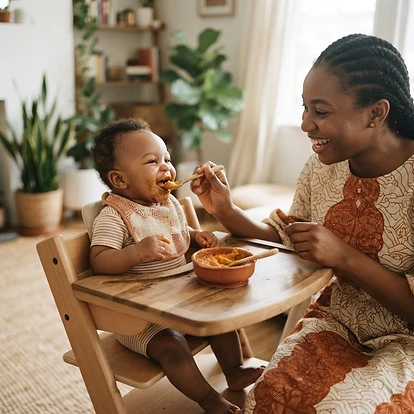
"When do I start giving food?" is usually followed quickly by "and what do I cook?" This guide answers both, using foods you already know and can buy in any market.
Start at six months, not before
Exclusive breastfeeding for the first six months — no water, pap, or agbo — is what both the World Health Organization and Nigeria's Federal Ministry of Health recommend. Around six months, a baby's iron stores begin to run low and their needs outgrow milk alone. Start then, and continue breastfeeding alongside food up to two years or beyond.
Signs of readiness: sitting with support and steady head control, showing interest in food, and losing the tongue-thrust reflex that pushes food back out.
The first two weeks: one food at a time
Begin with one to two teaspoons once a day, then build up. Offer iron-rich foods first, because iron is the nutrient most likely to be missing:
- Well-cooked egg yolk, mashed
- Thoroughly cooked and mashed beans, or smooth bean paste
- Mashed potato, sweet potato, yam or plantain
- Iron-fortified infant cereal, mixed with breastmilk if you can
- Stewed and mashed liver or small soft fish with all bones removed
Give one new food at a time, over two to three days, so you can spot a reaction. Offer a little water in a cup with meals once food starts.
A simple 6-to-12 month chart
6–8 months. Two to three meals a day. Smooth purées moving to thick mashes. Spoon-feed responsively: watch your baby's cues, never force the last spoon. Examples: ogi thickened with ground crayfish and a little mashed egg; mashed beans with soft rice; sweet potato with a drop of palm oil; mashed pawpaw.
8–10 months. Three meals plus one snack. Add soft finger foods so your baby practises picking up: soft cooked carrot, ripe banana pieces, soft yam cubes. Introduce minced chicken, fish, beans, and mashed vegetables such as ugu, ewedu and pumpkin leaf.
10–12 months. Three meals and two snacks, roughly a small bowl per meal. Most babies can manage well-chopped family food by now, as long as it is not spicy-hot, salty or bony. Continue breastfeeds around meals.
Foods to avoid before one year
- Honey — risk of infant botulism, even in tiny amounts
- Added salt and stock cubes — a baby's kidneys cannot handle it; season with onion, crayfish, pepper-free spices and herbs
- Added sugar and sweetened drinks, including malt drinks and juice
- Cow's milk as a main drink — small amounts in cooking are fine, but not as a replacement for breastmilk before twelve months
- Whole nuts, popcorn, grapes and hard chunks — choking risks; use smooth pastes instead
- Unpasteurised milk and raw or undercooked meat and eggs
Practical notes for Nigerian kitchens
Grind crayfish and dried fish finely so bones are not a hazard. Blend beans into a smooth paste rather than serving whole beans early on. Palm oil in small amounts adds energy and vitamin A. If money is tight, eggs, beans, groundnuts (as a smooth paste), dark green leaves and small dried fish give excellent nutrition for very little. Clean water for drinking and for washing hands and utensils matters as much as the food itself.
Do not stop breastfeeding to "make room" for food. Milk still supplies a large share of a baby's energy and immune protection through the first year.
Red flags to discuss with your health worker
Persistent refusal to eat, choking or coughing with every feed, blood in the stool, repeated vomiting, swelling or a rash after a specific food, or weight that stops increasing. Feeding difficulties can be related to tongue-tie, reflux or illness — none of which you should try to diagnose alone.
If you are also deciding how to wind down breastfeeding, read how to stop breastfeeding gradually. For day-to-day support, connect with other mothers in the same season, keep a note of how you are feeling in the daily Mum Check-In, and browse practical courses in the Learning Hub.
This is general information, not medical advice. Ask your paediatrician or primary health centre about your baby's specific needs, and follow the growth and feeding guidance they give you.


